el palomar
La piel del tamborel palomar, the tower observatory of the Bruner house, holds together two very different kinds of looking: the astronomer’s study of the heavens and Carlota Bruner’s vigil for a ship that never came back in time. Its history makes the tower both a room of scientific curiosity and the intimate setting of a family tragedy; later, it remains a working observatory used by Father Ferro and a charged memorial space for Macarena Bruner.
The Tower and Its Uses
The Bruner family called the house’s tower el palomar because it had once housed pigeons. Carlota’s father, Luis Bruner, was interested in astronomy and installed an observatory there. The room subsequently became the place where Carlota was confined for the final years of her life, turning a space built for looking outward into the setting of a life narrowed by family authority and loss.
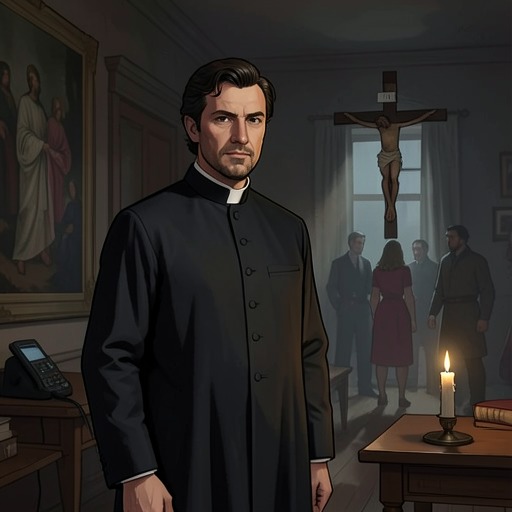
In the present, Father Ferro uses the observatory with the Duchess’s permission. He keeps books there, including works of literature as well as treatises on cosmography, celestial mechanics, and astrophysics. The room’s working equipment includes an old, nearly two-metre-long brass azimuth telescope on a wooden tripod. Ferro tends it carefully, polishing its tube with a handkerchief; the observatory is not simply a relic, but a place where he continues to pursue his interest in astronomy.
Carlota’s Vigil
From the tower, Carlota watched Manuel Xaloc leave Seville aboard the schooner Nausicaa. Her family would not let her say goodbye. She later insisted that she could see him on the stern, waving a handkerchief until the vessel disappeared downriver, though the distance made that sight impossible. The tower thus became the fixed point from which she imagined both the departure and the hoped-for return.
During Xaloc’s years away, Carlota wrote to him almost weekly, but her father bribed the city’s postal officials to intercept the correspondence. She received no letters for six years, and the family believed that Xaloc received none of hers. In a surviving letter, Carlota describes climbing to the tower during the silent hours of the afternoon and sitting in a rocking chair to watch the river for the white sails that might bring him home. Her waiting combines fidelity with increasing desperation: at times she fears he has forgotten her, while signs in dreams and paintings seem to renew her hope.
When Xaloc eventually returned, Carlota had lost her reason and could not recognize him. The observatory’s history therefore carries a stark reversal: the room that had extended her sight across the river could not restore the years of news and recognition stolen from her. Its astronomical equipment and its view cannot overcome the human interference that shaped the tragedy.
A Changed View of Seville
When Quart visits the tower with Father Ferro, the telescope stands beside arches in the Mudejar gallery, open on all four sides above the rooftops of Santa Cruz. The distant view takes in the Giralda, the Tower of Gold, and a stretch of the Guadalquivir River. But the landscape Carlota once watched has been transformed: modern buildings of concrete, steel, and glass occupy much of the view, and no white sail appears on the river.
The view also joins private memory to the city’s older history. The four pinnacles of the Archivo de Indias rise above the former Lonja, whose papers, dust, and records preserve what the present landscape has displaced. The tower’s elevated prospect might promise distance and clarity, yet it reveals change more readily than it restores the past. The old room remains, but its horizon no longer resembles the one Carlota watched.
Memory and Inheritance
Macarena’s account of the Bruner history gives the tower meaning beyond its architecture. She understands her defense of Nuestra Señora de las Lágrimas and her memory of Carlota as part of a personal struggle against time and forgetting. The tower is central to that inheritance: it is where Carlota watched Xaloc depart, where she waited in hope, and where her confinement made the cost of that hope visible.
For Macarena, preserving the family’s story is bound up with her sense of obligation to the name she bears and to the things she loves. The observatory consequently acts as both physical setting and memory-bearing space. Its former pigeon loft, astronomical apparatus, present-day books, and changed view do not erase Carlota’s vigil; they make the contrast between what she saw, what she imagined, and what the modern city now contains impossible to ignore.